Showing posts with label Wood turning machines. Show all posts

Wednesday, January 23, 2013

wood lathe

Shop Fox Mini Wood Lathe 10" x 15". New never used. Runs great! Retails for $392.20 (MSRP + tax) The brown spots on the lathe in the pictures are grease on the lathe, they are not stains.

All cast iron construction and a 1/2 HP motor provide plenty of power and stability to turn bowls up to 10" wide and spindles up to 15-1/2" long, or 38" long with the optional Extended Bed. This stable bench-top wood lathe has six speeds ranging from 480 to 4023 RPM, providing the flexibility for any turning project. Includes: Live center, spur center, 3" face plate, and tool rest.

Asking $320 cash, or best offer.

Specs:
• Motor: 1/2 HP, 110V, 6A single-phase
• Swing over bed: 10"
• Distance between centers: 15-1/2"; (38" with optional extension bed)
• Tail-stock travel: 3-1/4"
• Swing over tool rest: 7-1/2"
• Speeds: 480, 1270, 1960, 2730, 3327, 4023 RPM
• 1" x 8 TPI right hand spindle
• Tool rest length: 6-1/4"
• MT#2 spindle taper
• MT#2 tail-stock taper
• Quick access speed changes
• Includes tool rest, live rolling center, spur center and 3" face plate
• Overall dimensions: 37"L x 8"D x 15"H
• Weight 102lbs.

Please ask me if you have any other questions about it.

Tuesday, March 15, 2011

Keeping Them Safe - Wood Turning Lathes

Woodturning is a hobby the fastest growth in North America and many other parts of the world. Lathes made their way into garages and basements in record numbers and security concerns bring with them. Fortunately, a wood lathe is one of the safest machines in the workshop today. Unfortunately, this can make people careless. Lathes are used to rotate the timber quickly, while cutting tools are used to remove wood chips and shavings and toss. Security must be considered essential to maintain the wood lathe tool in its class for sure.

When you think lathe safety consider four areas:

    Hands and other body parts. To reduce the woodworking tools must be strong. Generally "It will reduce maple, you cut." Dull tools are dangerous because they slip and catch. Sharp tools cut you if they are allowed. Never point the tool tip to yourself and always put tools so they do not fall and hurt you, or you put your hand on a sharp tip.
    Eyes. Wear a face mask. Lathes and chips thrown in his face as you turn. Safety glasses are just not enough protection, even though wearing them under the shield will add another layer of security. Be sure to get a shield that does not fog up as you breath and wear, even for small parts. A capture can send a small object to draw on your face. Keep the shield on sharpening. It provides a security advantage that the typical small grinding guards do.
    Ears. Although most of the rides are pretty quiet, there is a need for tools other times, especially when the sanding. Then it will probably turn a drill, and a dust collector or shop vacuum will at the same time. earmuffs go a long way in prevention of deafness over time.
    Nose and lungs. When sanding, even with a dust collector, there are a lot of dust around the lathe, especially with the current trend to use finer pumice. This dust is a hazard to the lungs and in some cases and to start the allergen. A dust mask is a long way to protect the lungs. While even the paper mask nuisance can be a help, a good mask cartridge style will work better and also help when applying finishes and glues.

Tuesday, March 8, 2011

Tips for woodturning beginners

.Here are a few tips to get you started:


Use sharp tools


This makes turning much easier and quicker, and means that the wood is cut smoothly. My bowl gouge needs sharpening about four times for one bowl, so you may wish to buy an electric grinder to make sharpening quick and easy.

Practice with each tool

It took me a while before I could cut smoothly and without dig-ins. So get yourself a piece of scrap wood and practice different techniques on it until you get good at them. For between centres work, you need to be able to: rough out (gouge), smooth (skew chisel), and form shapes (parting/beading tool, spindle gouge). When I make bowls, I use only one tool (a bowl gouge) for almost everything, so don't feel that you must have loads of tools to begin with! Also, try not to be put off if a tool snatches (usually the skew chisel) as this will be remedied with practice.

Get a book or video

There are lots of woodturning books and videos which I found very useful. If there is another woodturner in your area, get in touch, but if not, books and videos give lots of advice and tips. They also show people actually woodturning so you can see what to do. There are lots of woodturning sites on the internet too

Use different grades of sandpaper

Start with the roughest, sanding until all tool marks are gone. Change to a finer grade to get rid of the rough sandpaper scratches. Finally, use an even finer grade to get the wood glassy smooth. I use '150', '240', and '320' sandpaper. You can get the wood even better still if you hold a handful of wood shavings against it to 'burnish' the surface.

Check before switching on

Before you start the lathe, spin the wood to check that it won't hit anything on the way round. Check that all bolts/clamps are tight too. Remember your safety glasses just in case the unexpected happens! If you are sanding the wood wear a dust mask, especially with exotic hardwoods.

Saturday, July 17, 2010

Sprayed Lacquer - Wood turning Techniques

    * Benefits * Easy to apply.
    
* Rapid process.
    
* Membership at 100% with underlying layers.
    
* Easy to erase.
    
Cons * Not as resistant to scratches.
    
* Low solids, it takes several layers.

Procedure:

 
This procedure is for spraying applications may, in particular, products of Deft lacquer.
1. Use shine for initial finishing coats. If you apply a wood finish that sealed the first coat will act as a sealant, spray two to three coats even. If you are applying to a surface that has been sealed, spray on two coats even. Allow to dry.
Note: pigment spots and common gel will seal a surface.
2. Lightly sand with 220 or 320 grains of paper, wipe the dust from the surface and spray on another coat of gloss, dry.
3. According to the absorption, you may need to repeat the previous step until the surface is smooth.

 
4. Sand lightly with 320 grit paper or 400 and wipe the dust from the surface. You can switch to another round now if you wish. Spray on the coat and let dry.
5.INSPECTION the surface and repeat the previous step if you wish.

 
6. You can choose to leave the surface in the state, or delete it depending on the desired look.
7. To clear the surface, sand lightly with sandpaper used in 1000 and then switch to # 0000 steel wool. Lacquer rubs very easily, using just enough force to ensure that every surface has the same brightness. Thoroughly clean the surface and apply paste wax or furniture polish.

Thursday, July 1, 2010

Getting started in woodturning


"Which lathe should I buy?"

This is a frequently asked question on woodturning discussion forums. As you should expect, there is no single answer that works for everyone's needs. Woodturning also involves much more than simply choosing a lathe.

Getting started in woodturning can be a confusing and frustrating task. There are literally hundreds of tools and accessories available. Turning is often referred to as "The Vortex" or "Slippery Slope", and for good reason. If you get too carried away you can quickly find yourself at the bottom of that slope wondering what happened! But with good research and wise buying you should be able to get started with the right tools for your needs at a reasonable cost.

How much, you ask? That depends on what your needs are.

This article won't determine your gear for you but perhaps it can substance a few pointers, pitfalls, and things to wait for in choosing the tract lathe, tools, and accessories for you. Movement is very some a "personal druthers" endeavor; there are few hard-and-fast rules that cover to all. The accumulation presented here is exclusive wilful to aid you in your investigate. It remains up to you to do that explore based on your specialised needs.

Nine Things I Wish Somone Had Told Me


by Jon Siegel


After more than four decades of woodturning it is difficult for me to remember how I first learned. I do remember seventh grade shop classes and also my father showing me the little bit he knew. Mainly, learning was by trial and error. As years went by, I got better at it, partly because I was exposed to some good books such as the classic by Frank Pain, The Practical Woodturner, but it became clear to me that woodturning was an obscure specialty. Many of the tools I saw in old books were not available.

Today woodturning is no longer obscure. The woodturning renaissance has had 30 years to mature – we have the American Association of Woodturners and hundreds of books and instructional videos. As a result, no one has to learn by trial and error in isolation as I did when I was a kid starting out in 1960. Nonetheless, in this article, I will attempt to help beginners not by giving simply a set of “tips”, but a list of items which fall into one or more of the following categories:

• Things I did incorrectly at first, and later had to “unlearn.”

• Things I should have learned sooner rather than later.

• Things I had to figure out on my own, because they were not in any books I had seen.

While I will jump around to many different topics, these represent some of the high points in my odyssey of discovery.

1 CUTTING VS SCRAPING – I wish my seventh grade shop teacher had said to me, “I’m teaching you the scraping method because you’re a beginner, but someday when you get serious about woodturning you’ll learn the cutting method.” If he had done so, I would have realized from the start that he was sending me down the wrong path.

Twenty years later, I found myself teaching shop, and I quickly discovered that you never learn something so well as when you must teach it. I developed this educational philosophy – don’t teach beginners the wrong way just because you think it might be easier for them to grasp. This does the students a great disservice and insults their intelligence. Show students the right way from the beginning, and be honest about the commitment required.

It’s easy to criticize my shop teacher now, but I don’t think he was purposely keeping anything from me. Rather I suspect he was not in possession of that information. In those days, industrial arts textbooks described mostly the use of scrapers. Gouges were used only for roughing out spindles. Many of these textbooks were written by authors whose expertise was mainly in metalwork and pattern making.
2 A LATHE IS NOT A VISE - I once translate in what I intellection was a esteemed storage that the wind should be situated between centers and the tailstock tightened as steely as affirmable! Yikes! Overweening unit from the tailstock causes a pack of problems - premature have on the headstock bearings, premature don on the tailstock halfway bearings, and most primal, motion of the workpiece. It took me a lasting second to substantiate that overweening make between centers was a solon contributor to workpiece Superfine Person - Kerosene wax, oversubscribed at marketplace stores for canning, makes an excellent stuff for your ride relief. Surmount apiece bar up into teeny pieces so you individual one within undemanding contact around your lathe. Use paraffin on the puppet quietus every digit or ten minutes. Use it on the lathe bed too. Everything testament go meliorate. Paraffin is such more favorable than paste wax from a can.

4 YOU DON'T Pauperization Galore CHISELS - I wasted a lot of period and money purchase chisels I didn't pauperism. As clip went on, I realized that there are only around fivesome chisels for arbor motion, and another quintet (concavity gouges and scrapers) for cross-grain transmute, that I rattling requirement. The chisels I no somebody use are mainly the oversized ones. Research to my article in the June, 2005 opening of The Old Saw for suggestions on the unexpendable chisels.

5 YOU WON'T GET FAR WITHOUT A Regular Put - Frankfurter Pain's assemblage introduced me to the skillfulness of using my forepaw to fixed the transmute and fall motility. As an sudden aid, I also learned that effort the affect with my fingers can recite me things active the attribute of the layer which my eyes incomparable could not find. But for a elongate experience, the plasticity of spindles was a limiting factor in my furniture designs. Patch I canvas use of the Intense TOOLS Positive Righteous TECHNIQUE EQUALS Fewer SANDING - In my previous life, I cerebration that it didn't concern more how you got the structure, because in the end you could soil the work into submission. The monition, which came gradually, is that inferior sanding is better for umteen reasons - sanding is drilling, sanding junk is horrific and sand toll money. But most central, the occupation looks amend with a peak of sanding because the surfaces are echt and the details are Deepen Discipline - Period ago, most lathes had manoeuvre pulleys with cardinal speeds - instant, faster and two more symmetric higher speeds which were so preposterously scurrying that no one ever victimised them. So essentially we had two-speed lathes and utilised the low motion for bowls and the indorsement modify for spindles. Today, lathes with locomotion pulleys jazz cinque or six speeds, but the problem has not denaturised. The smallest intensify is not low sufficiency and the drunk speeds are noneffervescent undignified. In statesman, all these lathes would be
8 FLAT GRIND – One day I discovered that chisels ground with a flat bevel work better than those that are hollow ground. I quickly re-ground all my cutting tools to the new flat grind, and I have never looked back. It’s hard to describe the feeling of that day. Without buying anything new or investing additional years of practice, I had suddenly made great progress in my ability, and I was seeing results that amazed me. If you attended the lecture by Michael Dunbar last September, you may remember he said the same thing about draw knives, scorps, etc. Any tool which is guided by riding the bevel should not be hollow ground.

9 THE JOY OF WOODTURNING IS DIRECTLY PROPORTIONAL TO THE MASS OF YOUR LATHE – This is not to say that I don’t like mini-lathes, I do. Any lathe that is built with all its parts in proportion with each other will function well on work pieces that are also in proportion to its size.

Back in the 70’s, I was fortunate to get a used Blount lathe (made in Milford, NH) which weighs about 500 pounds. My experience with that lathe resulted in a great leap forward. In particular I think having a well designed tool rest on a 300 pound cast iron bed made me realize how turning should feel. Now I have three lathes at 50, 500, and 5,000 pounds, and the Blount holds the middle ground.

Whether you are learning from books, magazines (like this one), videos, classes, or symposium demonstrations, be thankful that today there are so many resources and such a tremendous body of knowledge on woodturning to carry you on your own personal odyssey of discovery.

Tuesday, June 15, 2010

what you know abut Woodturning


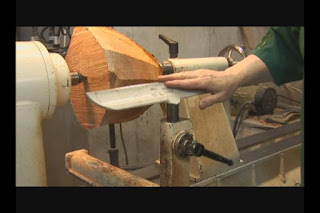
Woodturning is a form of woodworking that is used to create wooden objects on a lathe (see: also antique wooden polelathe). Woodturning differs from most other forms of woodworking in that the wood is moving while a stationary tool is used to cut and shape it. Many intricate shapes and designs can be made by turning wood.
There are two distinct methods of turning wood: spindle turning and faceplate turning. In spindle turning, the wood is fixed between 2 points. The spur center digs in to the wood and is powered by a motor. The other, a hard center or a live center may be a point or set of points in the tailstock. In face plate turning, the wood is secured with screws to a faceplate or in a chuck or jig. the tail stock and a center may also be used for added support on large pieces with a faceplate. Most bowls, platters and many vessels are face plate turned, while, Pens, furniture legs, spindles, and some vessels are spindle turned. The method used may differ depending on the shape of the blank and the technique of the turner, and both methods may be used on the same piece.
When author is cut in such a way that the textile state cut is not supported by the cloth beneath it, it tends to displace and revel. This "tearout" exhibits a nubby, highly peeling perception organ texture and greatly reduces the appreciate of any quantity exhibiting it. The instruction of cut is contrary in shaft turn and faceplate turning because excerpt in the wicked route can create tearout. Mandrel motion cuts are prefab from patch, and from the mechanism toward the inaccurate when hollowing. When faceplate turn, the opposition applies.

.source : http://woodlatheworks.blogspot.com/

Woodturning products from Barley Wood Ltd


Staircases and staircase parts - Wood turning

Friday, June 11, 2010

water-powered,Oddball wood lathe

 water-powered,Oddball wood lathe
Just a lathe for working bobbins, in an old textile mill. The headstock and tailstock are typical of early wood turning lathes having a wooden know, but this has an iron bed and automated feed. I supposed that the lathe is an dental amalgam of different items. The bed is too narrow compared with the headstock and tailstock and coach.